✦ The Immigrant's Fist ✦
His Fists Were
His Ticket Out
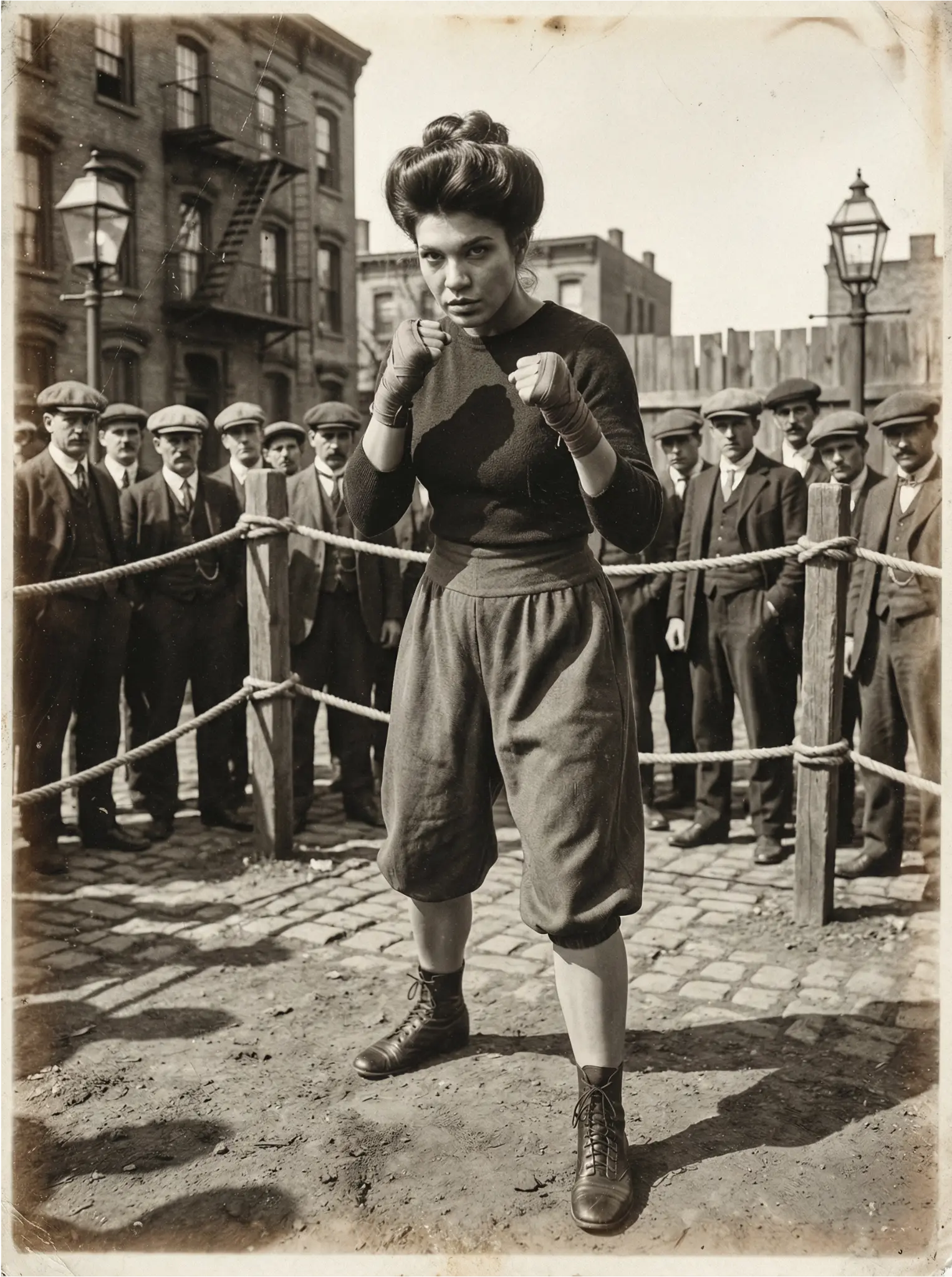
From the moment the first boats docked at Ellis Island, the boxing gym was waiting. No English required. No references needed. No money necessary. Just heart, hands, and the willingness to bleed for something better.
The Irish came and gave us John L. Sullivan, the first great American sports hero — a saloon keeper's son from Roxbury, Massachusetts, who became the most famous man in the country. The Italians came and gave us Rocky Marciano, the son of a shoe factory worker from Brockton who went 49-0 and never lost. The Jews came and gave us Benny Leonard, the Ghetto Wizard from the Lower East Side, who used his fists to earn the respect that the streets of New York refused to give him freely.
The Black men came from the South, fleeing Jim Crow and looking for a fair fight — and in the ring, for the first time, they found one. Jack Johnson. Joe Louis. Sugar Ray Robinson. Muhammad Ali. They didn't just win championships. They won something more important: dignity.
The Puerto Ricans came to New York and gave us Carlos Ortiz and Wilfredo Gomez. The Mexicans gave us Julio Cesar Chavez. The Cubans gave us Kid Gavilan. Every wave of immigration to this country has produced champions, because every wave of immigration has understood something that the native-born sometimes forget: nothing worth having comes without a fight.
"The gym was the first place in America where a man with nothing could become something. That's still true. That will always be true."
✦ The National Sport ✦
Boxing Shaped America
From the tenements of the Lower East Side to the White House, boxing has been woven into the fabric of American life for more than a century.
1880s–1900s
The Birth of American Boxing
John L. Sullivan becomes the first great American sports celebrity. Bare-knuckle fighting gives way to the Marquess of Queensberry Rules. The sport moves from the back alleys to Madison Square Garden. A nation of immigrants finds its first shared hero.
1910s–1920s
The Golden Age
Jack Dempsey, the Manassa Mauler, becomes the most feared man in America. His fights draw the largest crowds in sports history. Gene Tunney defeats him twice — with brains over brawn — and then retires to read Shakespeare and lecture at Yale. The sport is at the center of American culture.
1930s–1940s
Boxing in the Depression & War
Joe Louis becomes the most beloved athlete in the country during the darkest years of the Depression. When he knocks out Max Schmeling in 1938, President Roosevelt calls it a victory for America. During World War II, more American servicemen box than play any other sport. The ring is where men become soldiers.
1950s–1960s
The Television Era
Rocky Marciano goes 49-0 and retires undefeated. Sugar Ray Robinson is called the greatest pound-for-pound fighter who ever lived. Then comes Cassius Clay — who becomes Muhammad Ali — and changes everything. Boxing is no longer just a sport. It is a mirror of America itself.
1970s–1980s
The Thrilla in Manila
Ali vs. Frazier. Ali vs. Foreman in Kinshasa. The Thrilla in Manila. These are not just fights — they are events that stop the world. Roberto Duran, Marvin Hagler, Thomas Hearns, Sugar Ray Leonard. The golden era of four-division champions. The sport is at its peak.
Today
The Tradition Continues
At Trinity Boxing Club, we carry this tradition forward. Every person who walks through our door is part of this story — the immigrant's story, the American story, the story of people who refused to be defeated. The tradition is alive. The work continues.


✦ The Men Who Proved It ✦
Boxing Builds the Mind
The connection between boxing and intellectual development is not coincidence. It is history.
1858–1919
Theodore Roosevelt
26th President of the United States
Theodore Roosevelt was a sickly child — asthmatic, nearsighted, physically frail. His father told him: "You have the mind but not the body. You must make the body." He took up boxing at age twelve and never stopped.
He boxed at Harvard. He boxed as a rancher in the Dakotas. He boxed as Governor of New York. He boxed in the White House — continuing even after a sparring partner's blow detached the retina in his left eye, leaving him blind in that eye for the rest of his life. He never told anyone until after he left office.
Roosevelt wrote thirty-eight books. He led the Rough Riders up San Juan Hill. He won the Nobel Peace Prize. He was the youngest president in American history. He believed that the strenuous life — the life of physical challenge and moral courage — was the only life worth living. Boxing was not separate from his greatness. It was part of it.
"I wish to preach, not the doctrine of ignoble ease, but the doctrine of the strenuous life, the life of toil and effort, of labor and strife."
1897–1978
Gene Tunney
Heavyweight Champion of the World, 1926–1928
Gene Tunney grew up in Greenwich Village, the son of Irish immigrants. He read voraciously — Shakespeare, Dickens, Emerson, Thoreau. He believed that the discipline required to master boxing was the same discipline required to master anything: total commitment, systematic study, and the refusal to accept limitations.
He defeated Jack Dempsey — the most feared heavyweight in the world — not through brute force but through superior preparation. He had studied every film of Dempsey he could find. He knew Dempsey's patterns before the first bell rang. He won because he was smarter.
After retiring undefeated, Tunney lectured on Shakespeare at Yale University. He was invited to speak at Oxford. He became a successful businessman and a director of several major corporations. The same mind that studied Dempsey's jab studied Hamlet's soliloquy. He is proof that the ring and the library are not opposites. They are partners.
"To me, boxing is like a ballet, except they hit you. The preparation, the discipline, the artistry — it is the same."
✦ The Neuroscience ✦
What Boxing Does to Your Brain
Neuroplasticity
Learning combinations, footwork, and defensive movement forces the brain to form new neural pathways at a rate that rivals chess and music.
Reaction Time
Boxers develop reaction times that rival any professional athlete. The brain learns to process visual information and generate motor responses faster than any other training method.
Focus & Presence
Three minutes in the ring requires a quality of attention that no office or meditation app can replicate. You cannot be anxious about tomorrow when someone is throwing a jab at your face.
Stress & Anxiety
Controlled confrontation is one of the most effective treatments for anxiety known to medicine. The ring teaches you that you can handle more than you think.
Executive Function
The split-second tactical decisions required in boxing — when to attack, when to defend, when to clinch — develop the same cognitive skills used in leadership and business.
Confidence
There is a particular kind of confidence that comes only from knowing you can handle yourself. Not arrogance. Just the quiet certainty that you have been tested and did not break.
✦ Words Worth Fighting For ✦
What the Great Men Said
"The credit belongs to the man who is actually in the arena, whose face is marred by dust and sweat and blood."
— Theodore Roosevelt
26th President of the United States, boxer
"A champion is someone who gets up when he can't."
— Jack Dempsey
Heavyweight Champion of the World, 1919–1926
"It's not the size of the dog in the fight, it's the size of the fight in the dog."
— Mark Twain
American author, boxing enthusiast
"Float like a butterfly, sting like a bee. The hands can't hit what the eyes can't see."
— Muhammad Ali
Heavyweight Champion of the World, three times
"I hated every minute of training, but I said: don't quit. Suffer now and live the rest of your life as a champion."
— Muhammad Ali
The Greatest
"Boxing is the ultimate challenge. There's nothing that can compare to testing yourself the way you do every time you step in the ring."
— Sugar Ray Leonard
Five-division World Champion
"To be a great champion you must believe you are the best. If you're not, pretend you are."
— Muhammad Ali
Louisville, Kentucky, 1942–2016
"The fight is won or lost far away from witnesses — behind the lines, in the gym, and out there on the road, long before I dance under those lights."
— Muhammad Ali
On preparation
"I am the greatest. I said that even before I knew I was."
— Muhammad Ali
The American Dream, personified
✦ The Door Is Open ✦
Come Be Part
of the Tradition
Roosevelt did it. Tunney did it. The immigrant kid from the Lower East Side did it. The grandmother from the Upper West Side does it every Tuesday morning. The tradition is alive. The work continues. All you have to do is walk in.